Facebook Reels Ads vs Feed Ads: Pros, Cons & When Each Wins
Direct answer: Searching “Facebook Reels ads vs Feed ads pros and cons”? Neither placement wins globally. Reels pros: full-screen vertical, sound-forward, strong for cold reach when creative is true 9:16 with audio and key messages inside Meta’s safe zone. Reels cons: UI chrome eats weak layouts; cropped Feed masters fail; skip behavior punishes slow hooks. Feed pros: pause-and-decide clarity for offers, kits, reviews, catalogs, and a lot of retargeting. Feed cons: many viewers never unmute; square/4:5 UGC that ignores Reels norms loses cold volume. If you only crop the same file into both surfaces, you did not run a placement test—you ran one concept against itself.
| Reels ads | Feed ads | |
|---|---|---|
| Best job | Cold prospecting, native vertical storytelling | Offer clarity, proof, catalogs, retargeting |
| Format contract | 9:16 video + audio + safe zone | 1:1 / 4:5 still or video; readable without sound |
| Main risk | Cropped Feed masters, chrome covering copy | Silent scroll past weak first frames |
| Fake test | One UGC file stretched to both placements | |
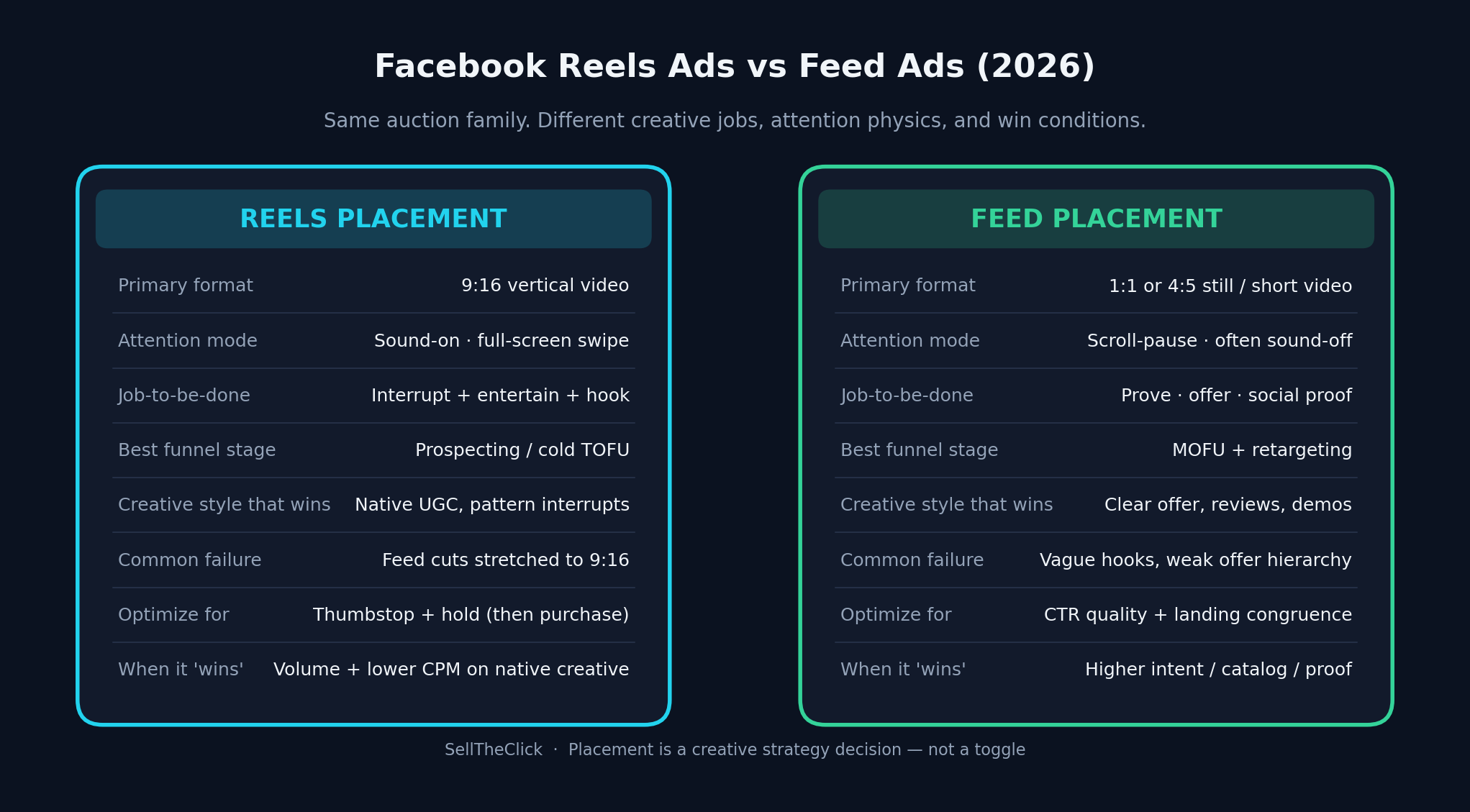
Why “Reels or Feed?” is the wrong first question
Media buyers still treat placement like a checkbox. Meta’s own product surfaces disagree. Reels is a full-screen vertical environment with UI chrome, skip behavior, and sound-forward norms. Feed is a mixed wall of content where many people never unmute. The delivery system can send budget to either surface; it cannot invent a format contract you never shot.
Meta documents Reels as a selectable placement under Advantage+ placements or manual Stories and Reels selection in Ads Manager.1 That is the “where.” The “whether it works” is almost always creative fitness + funnel job.
What Meta actually documents (facts, not vibes)
Aspect ratio and Reels design
Meta’s placement aspect-ratio tables list 9:16 among the ratios supported for Facebook Reels and Instagram Reels, and call out 9:16 as recommended for those vertical surfaces.2 Meta’s Reels advertising materials and Ads Guide design notes emphasize building in 9:16 video with audio and keeping critical elements inside the safe zone—not stretching a square Feed still and hoping.34
Safe zone (official design guidance)
Meta’s Reels design recommendations ask advertisers to leave roughly 14% of the top, 35% of the bottom, and 6% on each side free of text, logos, or other critical elements so profile UI, captions, and CTAs do not cover the message.4 That is not a creative opinion; it is platform chrome physics.
Meta-published creative tests on Reels
On Meta’s Reels ads product page, Meta reports that campaigns including 9:16 video ads with audio and key messages in the safe zone saw 2× higher delivery to the Reels placement and, in analyzed split tests, 34.5% lower cost per result versus image ads on Reels (global meta-analysis of split tests across ecommerce/retail/CPG; Meta states high statistical confidence).3
Read that carefully: it is Meta’s reported test outcome for creative quality on Reels, not a promise that turning on Reels will cut your blended account CPA by 34.5%. If your “Reels ads” are still images or non-native video, you are outside the condition Meta tested.
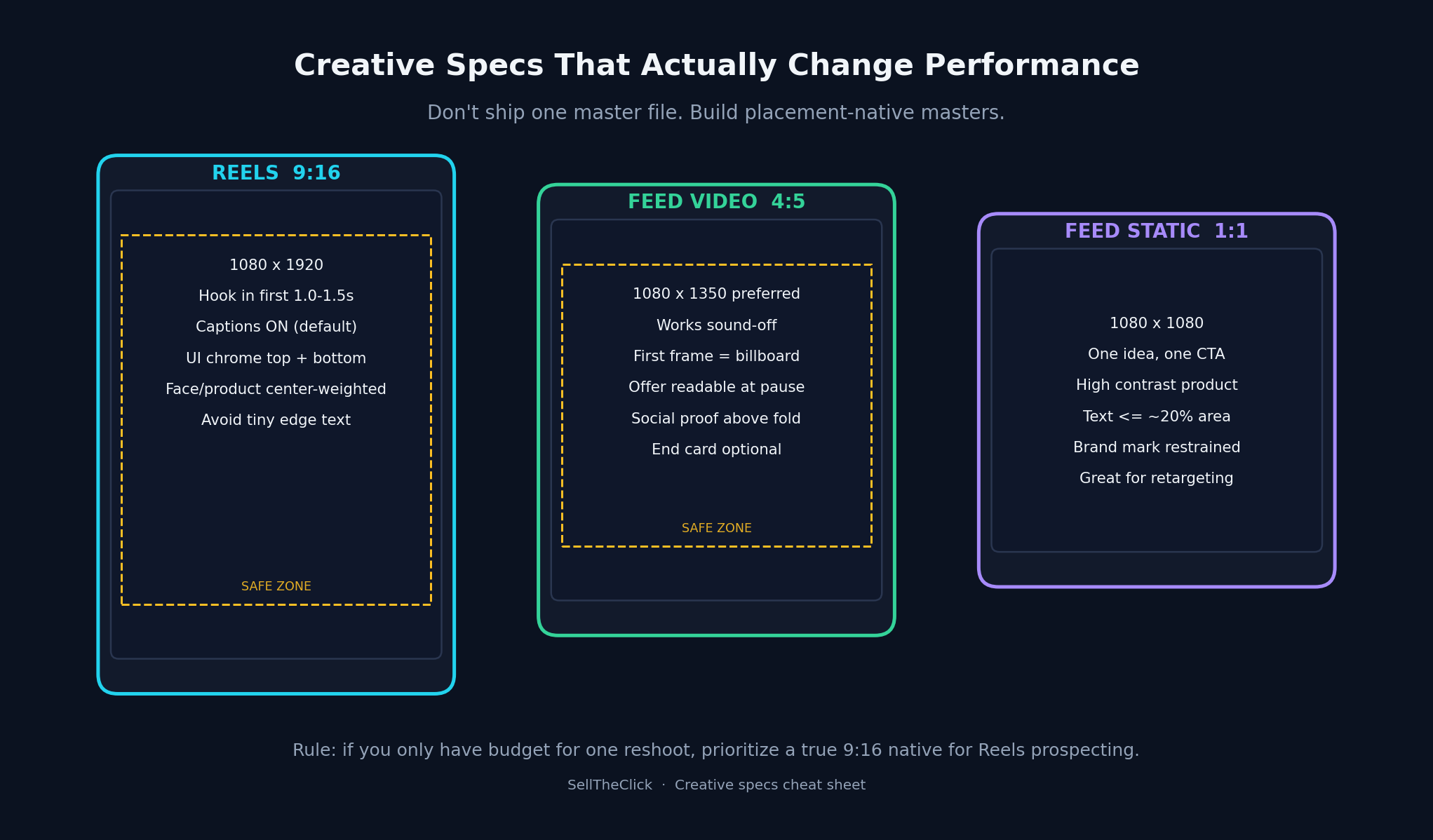
Reels vs Feed at a glance
| Dimension | Reels | Feed |
|---|---|---|
| Canvas Meta optimizes for | 9:16 vertical video23 | 1:1 and 4:5 common; multiple ratios supported2 |
| Attention mode | Full-screen swipe; sound-forward | Scroll-pause; often sound-off |
| Primary job | Interrupt → open loop → entertain | Prove → clarify offer → click |
| Best funnel bias | Cold / prospecting / creative testing volume | Warm / retargeting / offer & catalog |
| Failure mode | Cropped Feed masters; safe-zone violations | Vague first frame; weak offer hierarchy |
| First metric gate | Delivery + early hold, then CPA | Link CTR quality + LP match, then CPA |
When Reels wins vs when Feed wins
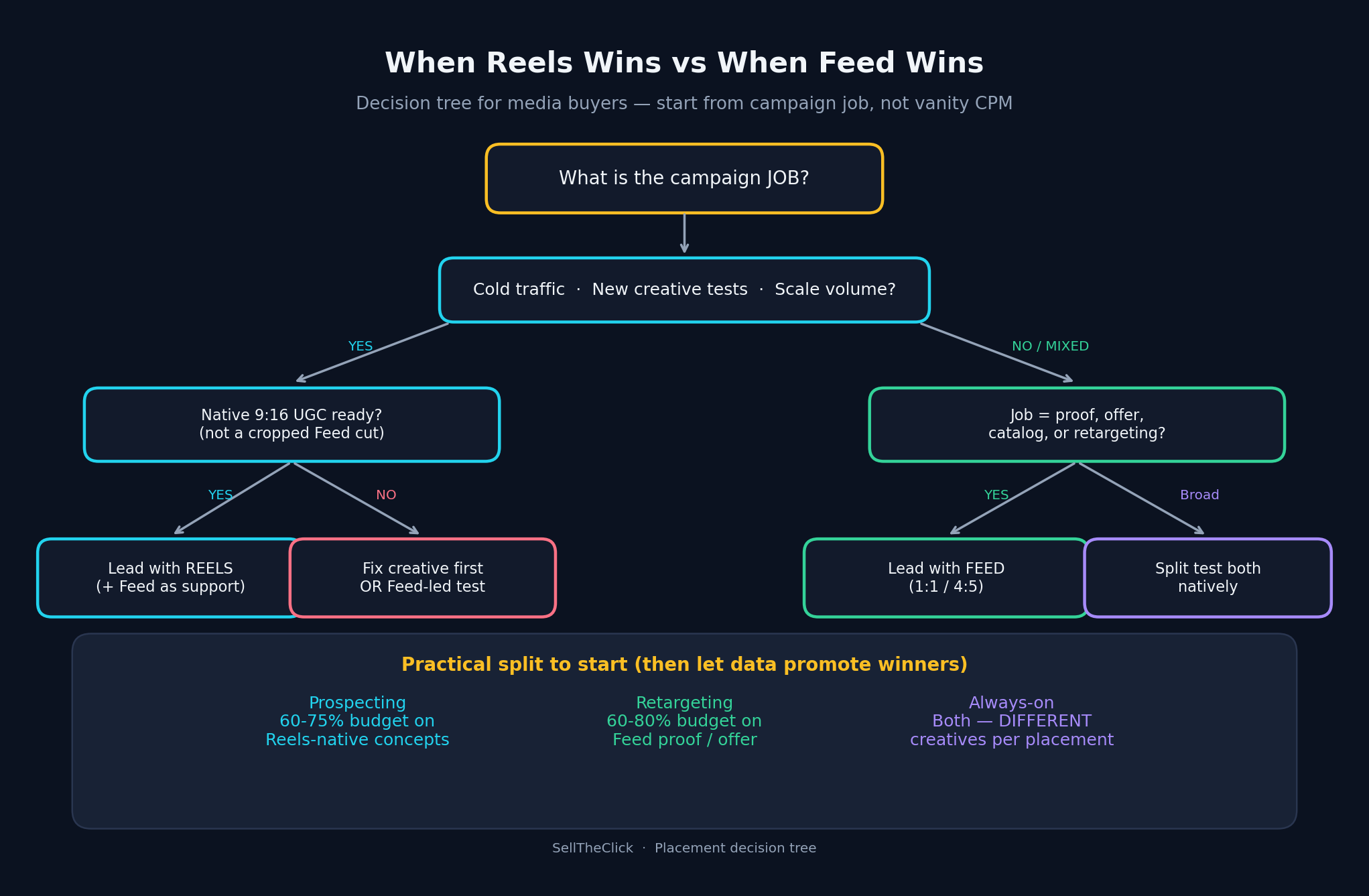
Lead with Reels when
- Job is new customer volume or hook/angle testing at cold.
- You have (or will shoot) true 9:16 with audio and safe-zone discipline.34
- The story is entertainment-compatible: demo, reaction, founder rant, rapid UGC.
Lead with Feed when
- Job is proof, price, kit math, catalog, or retargeting.
- Creative is static-led or must work sound-off as a billboard.
- You need offer literacy more than swipe interruption.
Practical starting split (then let data promote)
- Prospecting: bias budget toward Reels-native concepts (often majority), with Feed support only if concepts differ.
- Retargeting: bias toward Feed proof/offer concepts.
- Always-on: both surfaces, different creatives—not one file in two shapes.
Setup notes (Advantage+ vs manual)
Meta describes two paths into Reels: Advantage+ placements (system can include Reels among surfaces) or manual placement selection including Stories and Reels / overlay options depending on product surface.13
- Use manual when you need clean learning on a Reels-only or Feed-only creative thesis.
- Use Advantage+ when you have multiple distinct, placement-capable assets and want the system to allocate.
- Do not “exclude Reels forever” as brand personality. Exclude after evidence—or because your library cannot support native vertical yet.
How to read the metrics without lying to yourself
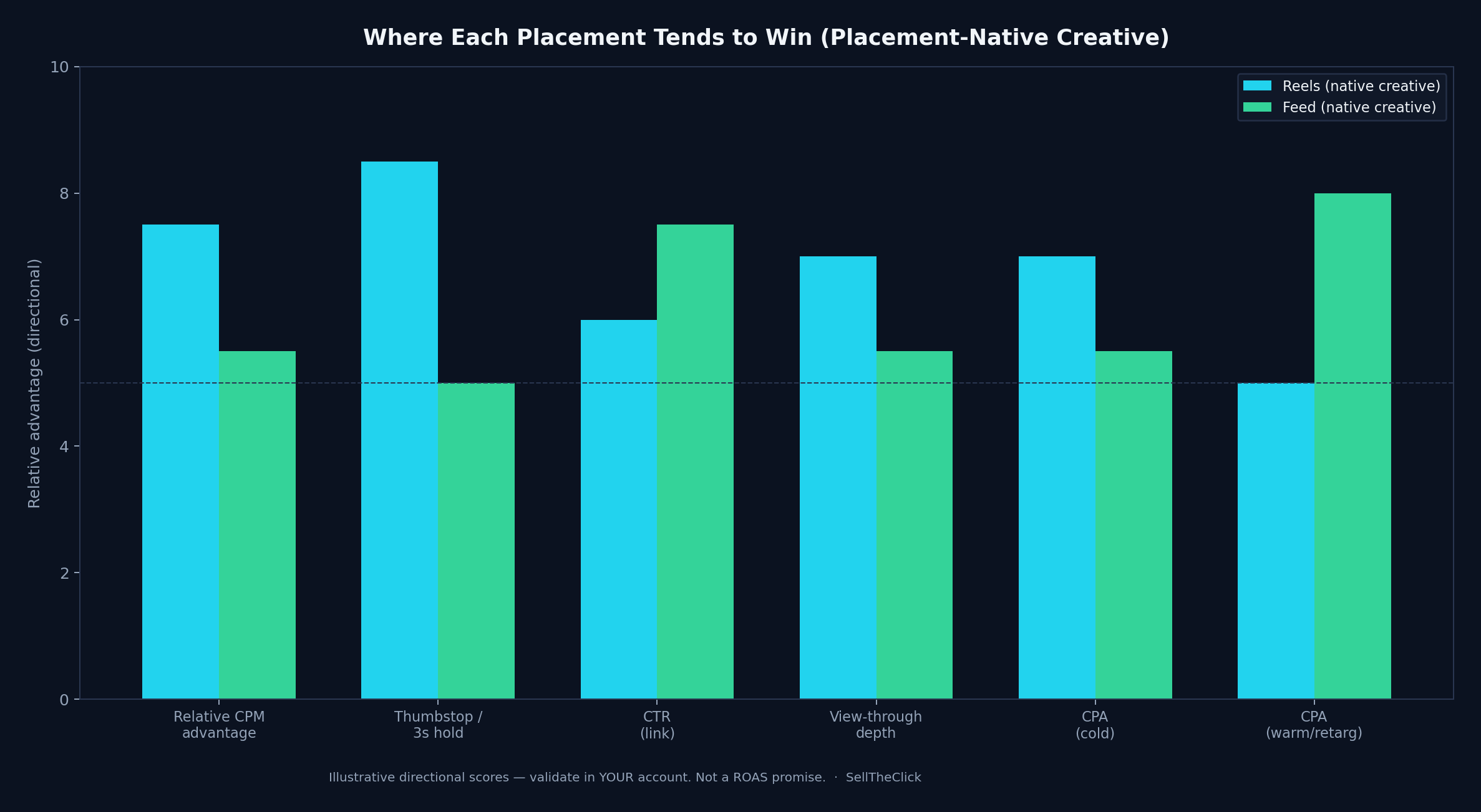
- Do not crown a winner on day-one CTR while learning is unstable.
- Do not compare warm Feed ROAS to cold Reels CPA without splitting funnel stage.
- Cheap Reels CPM on ignored video is a tax, not a win—pair delivery with hold/quality.
- Meta’s 2× delivery / lower CPR figures apply to the creative conditions they tested (9:16 + audio + safe zone), not every Reels toggle.3
The first three seconds are different jobs
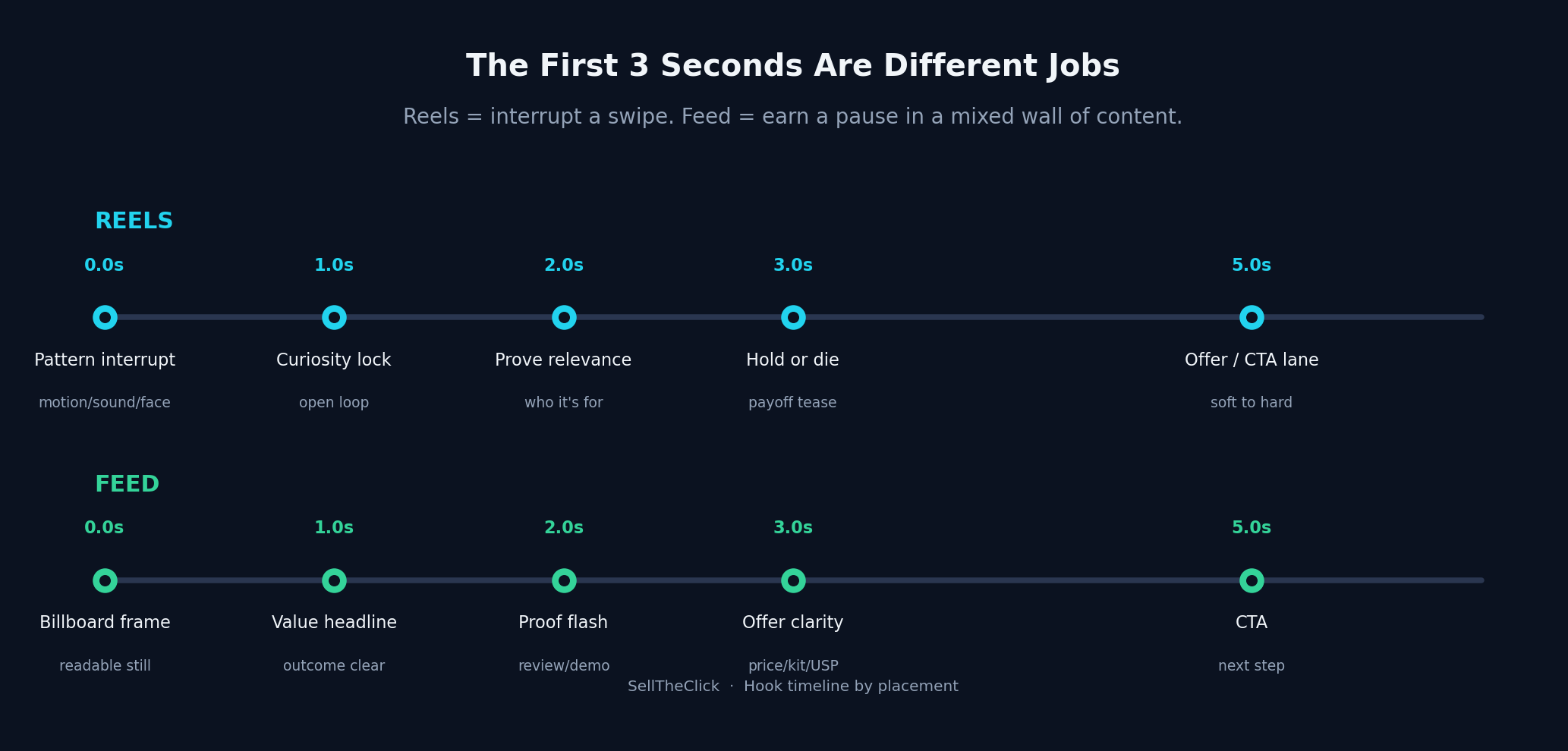
Reels: pattern interrupt → curiosity lock → relevance → hold → offer lane.
Feed: billboard frame → value headline → proof flash → offer clarity → CTA.
Rewrite test: take your best Feed winner. Does second 0 interrupt a vertical swipe, or only work as a paused still? If the latter, it is not a Reels ad yet.
Placement diversity ≠ creative diversity
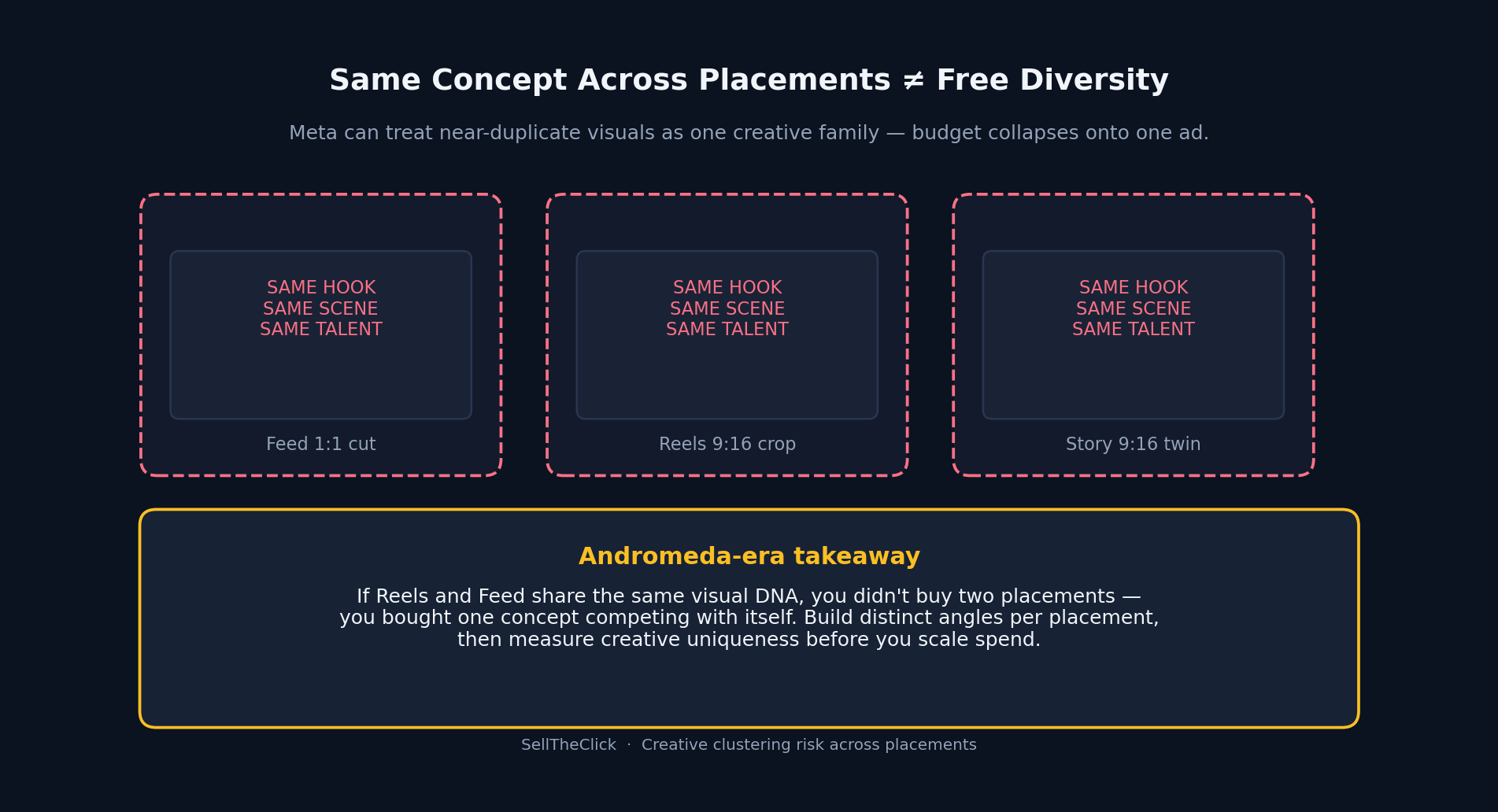
Buyer-visible pattern: near-duplicate variations often show spend concentrating on one sibling while others sit on crumbs of delivery. Treat “entity / clustering / similarity” language as a practitioner working model for that symptom—not as a claim about unpublished Meta source code. Separately, Meta’s own engineering write-up on Andromeda describes a next-gen ads retrieval stack built for much larger creative volume from Advantage+ and gen-AI ads; retrieval is the stage that shortlists candidates before ranking.5 Practical takeaway for this article: lazy placement clones are not free diversity in a creative-first retrieval world.
Fix: different hook, scene, talent, or motion pattern per surface—not only a taller export. If you need a pre-spend uniqueness check across concepts, that is the job SellTheClick is built for.
Seven-day implementation
- Audit top spend ads: tag Reels-native / Feed-native / Frankenstein crop.
- Kill safe-zone violations on any vertical you keep.4
- Shoot or recut 3 true 9:16 concepts (not crops).
- Build 3 Feed-native proof/offer concepts (4:5 or 1:1 as fit).2
- Structure tests by funnel stage (cold vs warm).
- Read new-customer contribution, not blended ROAS alone.
- Check delivery concentration across “variations” before scaling the set.
Common mistakes
- Stretching 1:1 into 9:16 and calling it a Reels strategy.
- Ignoring Meta’s safe-zone margins on vertical.4
- Expecting Advantage+ to fix missing native creative.13
- Comparing cold Reels to warm Feed without a split.
- Identical hooks on both surfaces (fake diversity).
- Optimizing pure entertainment proxies when the KPI is purchase.
- Daily placement thrash that resets learning while blaming Meta.
FAQ
Do Facebook Reels ads beat Feed ads in 2026?
No universal winner. Reels often wins cold when creative is native 9:16 with audio and safe-zone respect; Feed often wins proof and retargeting. Match job → creative → placement.
What aspect ratio should I use for Reels ads?
Build for 9:16. Meta lists 9:16 for Reels placements and recommends vertical video for that surface.23
What is the Reels safe zone?
Meta’s guidance: keep critical elements out of roughly the top 14%, bottom 35%, and 6% sides so UI does not cover them.4
Should I use Advantage+ placements?
Yes when you supply multiple placement-capable creatives. No when you have one square asset and hope the system “finds Reels.” Meta notes Advantage+ can include Reels among placements.13
Can I reuse the same Feed ad on Reels?
Technically yes; strategically weak. Meta’s published Reels creative tests favor native 9:16 + audio + safe zone over image-style treatments.3
Did Meta publish performance data on Reels creative quality?
Yes—2× higher Reels delivery and 34.5% lower cost per result vs image ads in Meta’s cited split-test meta-analysis for 9:16 video with audio in the safe zone.3 Validate in your account; do not treat it as a guarantee.
How does Andromeda relate to placements?
Andromeda is Meta’s retrieval-layer rebuild for ads recommendation, designed around much larger creative volume.5 It does not replace the need for placement-native creative; it raises the cost of lazy near-duplicates.
Conclusion
Reels vs Feed is staffing, not sports. Hire Reels to stop the swipe at cold with native vertical. Hire Feed to prove and close with clarity. Fire the habit of one master file everywhere. When Meta already publishes that native 9:16 + audio + safe zone changes Reels economics,3 shipping square crops is not a strategy—it is voluntary tax.
Next step: tag your live library for Frankenstein crops, rebuild a true Reels-native set, and only then let Advantage+ or manual pins allocate. If you want a pre-spend read on whether “variations” are actually distinct concepts, run them through SellTheClick.
References
- Meta Business Help Center — About ads on Facebook Reels (placements via Advantage+ or manual Stories/Reels).
- Meta Business Help Center — Aspect ratios supported by placements in Meta Ads Manager (Reels 9:16 support/recommendations).
- Meta for Business — Instagram & Facebook Reels ads (9:16 + audio + safe zone; reported 2× Reels delivery and 34.5% lower CPR vs image ads in Meta split tests).
- Meta Ads Guide — Instagram Reels video design recommendations (safe zone ~14% top / 35% bottom / 6% sides; 9:16; audio strongly recommended).
- Engineering at Meta — Andromeda: next-gen personalized ads retrieval engine (retrieval stage; capacity for Advantage+/gen-AI creative volume).