Solopreneur GTM Strategy: The 9×9 Roadmap You Can Actually Run
Direct answer: A go-to-market (GTM) strategy is not a content calendar. It is the plan for how a specific offer reaches a specific buyer, gets chosen, gets paid for, and expands — under real limits of time, money, and product maturity. For solopreneurs, GTM fails when you run five channels and zero conversations. It works when you lock one ICP × one offer × one primary channel for 90 days, then turn talks into paid proof.
What GTM actually is (and is not)
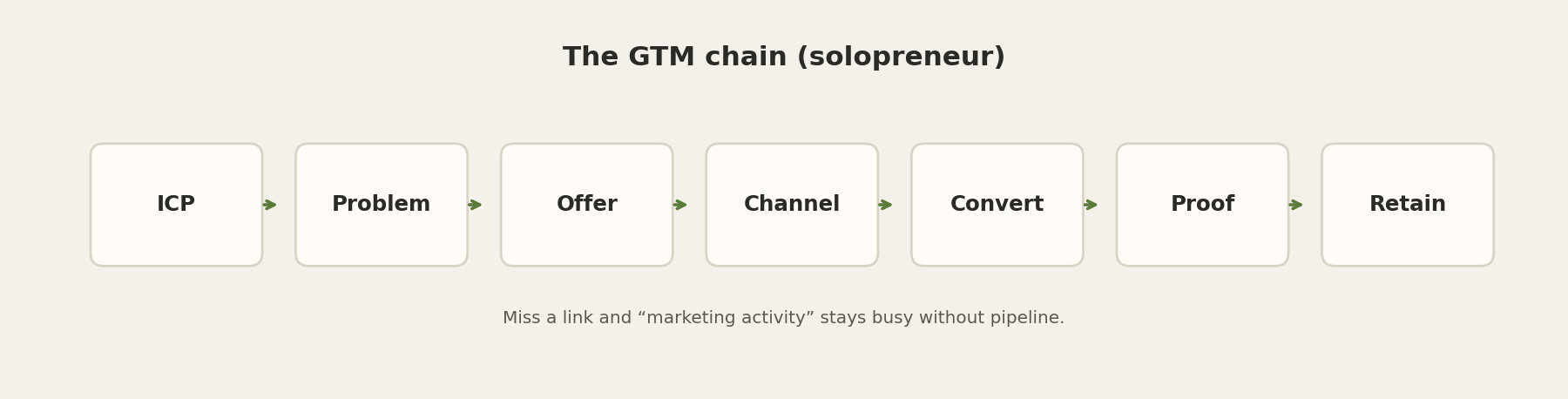
GTM answers a short chain. Miss a link and “marketing” becomes noise.
- ICP — Who is the first customer you can name, not “everyone on Meta”?
- Problem / mechanism — What expensive leak do you fix in one sentence?
- Offer — Is scope productized enough that every sale is not a custom project?
- Channel — Where does that person already hang out?
- Conversion path — Self-serve, call, audit, waitlist — pick one primary.
- Proof — What can you show in under two minutes that lowers risk?
- Retention / loop — Why do they come back or refer?
GTM is not a logo, a landing page with no distribution, five half-alive social accounts, feature lists pretending to be positioning, or vanity follower counts with no pipeline.
GTM motions: pick one primary
A motion is the main engine that creates customers. Solos almost always need one primary for 90 days. Hybrid comes after signal.
| Motion | How customers arrive | Best when | Solo fit |
|---|---|---|---|
| Outbound / sales-led | You reach them (DM, email, intro, audit offer) | Clear ICP list; offer needs explanation | Fastest validation; time-heavy |
| Content / inbound | They find your ideas (X, SEO, YouTube, newsletter) | You can teach a sharp problem weekly | Compounds; slow 3–6 months |
| Product-led (PLG) | Product sells via trial / freemium | Value in minutes; simple pricing | Hard until product is sharp |
| Community-led | Peers recommend you inside a scene | You already have niche credibility | Long build; high trust |
| Partner-led | Agencies, tools, creators send deals | Clear attach product (audit, plug-in) | Strong after one case |
| Paid-led | Ads buy attention → landing → offer | Unit economics known | Risky early; optional later |
Skills solopreneurs need
You do not need world-class skill in everything. You need competence on the critical path.
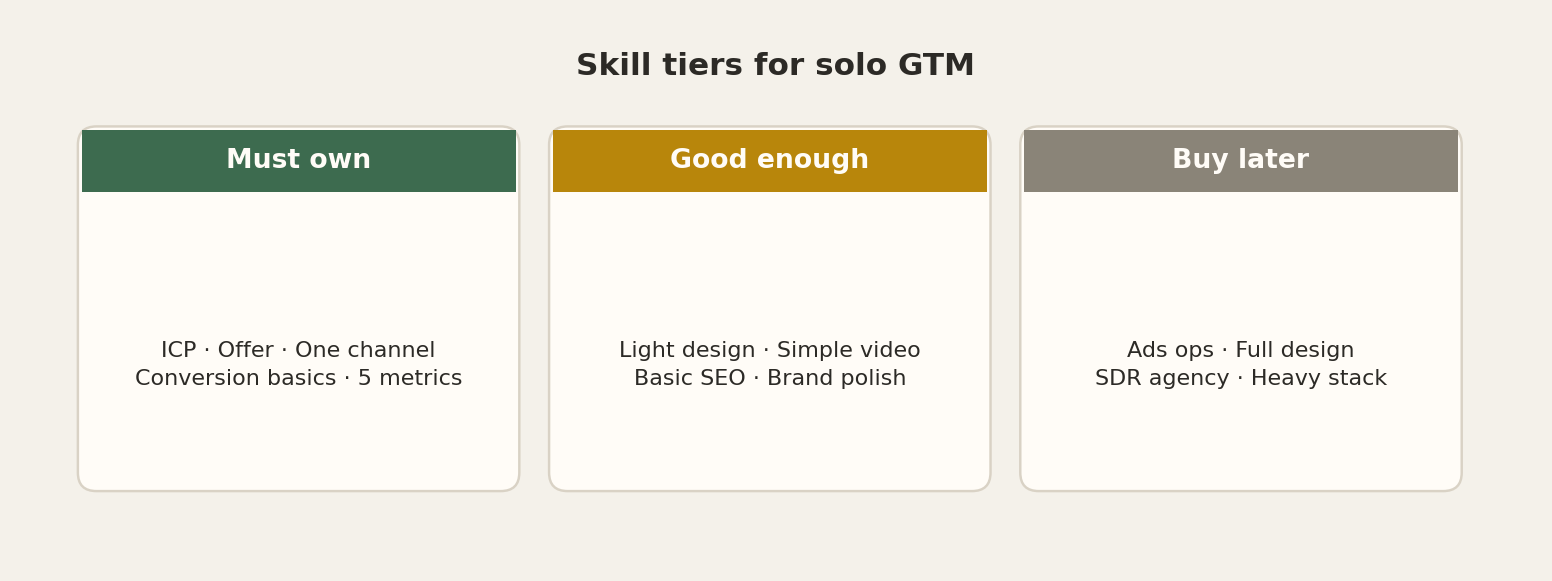
Must own
- ICP / problem hunting — spot expensive, recurring leaks
- Positioning — for whom, against which alternative
- Offer design — fixed scope, price, deliverable list
- One channel craft — write, post, or DM well on a single surface
- Basic conversion — message match, CTA, discovery structure
- Simple measurement — 3–5 numbers, not 40 dashboards
Can stay thin / buy later
- Polished design systems, heavy video, advanced SEO programs
- Ads management at scale, full design retainers, SDR agencies — after revenue
Can GTM be learned?
Yes. GTM is a practiced craft, not a personality type. What looks like “natural marketers” is usually tight ICP, high reps, and short feedback loops.
| Horizon | Learnable |
|---|---|
| Weeks–months | Clear posts and DMs, discovery interviews, simple funnel, outbound cadence, weekly KPI ritual, productized wedge offer |
| Quarters | Hook taste for your niche, scene trust, pricing power, partner network, compound content library, instinct for when to kill a motion |
Courses teach labels. Pipeline feedback teaches judgment: ship weekly → talk to buyers → change the offer → measure → repeat.
What it takes (non-negotiables)
| Input | Realistic minimum | Why |
|---|---|---|
| Time | 5–10 hrs/week protected GTM | Sporadic posts do not compound |
| Focus | 1 ICP × 1 offer × 1 channel for 90 days | Split focus is fake busy |
| Money | Low tool spend first; paid ads after signal | Spend cannot fix a mushy offer |
| Proof | 1 teardown, demo, or paid pilot story | B2B buys reduced risk |
| Feedback | 8–12 real ICP conversations / month early | Analytics without talks lie |
| Integrity | No fake metrics, no identical spam replies | Niche memory is long |
Failure mode #1 for tool founders: shipping features as avoidance of distribution. GTM time is a product requirement, not a side quest.
The 9×9 GTM grid (visual)
Rows = stages (Discover → Scale). Columns = pillars (Insight → System). Work left-to-right inside one stage. Do not jump to Scale with an empty pipeline.
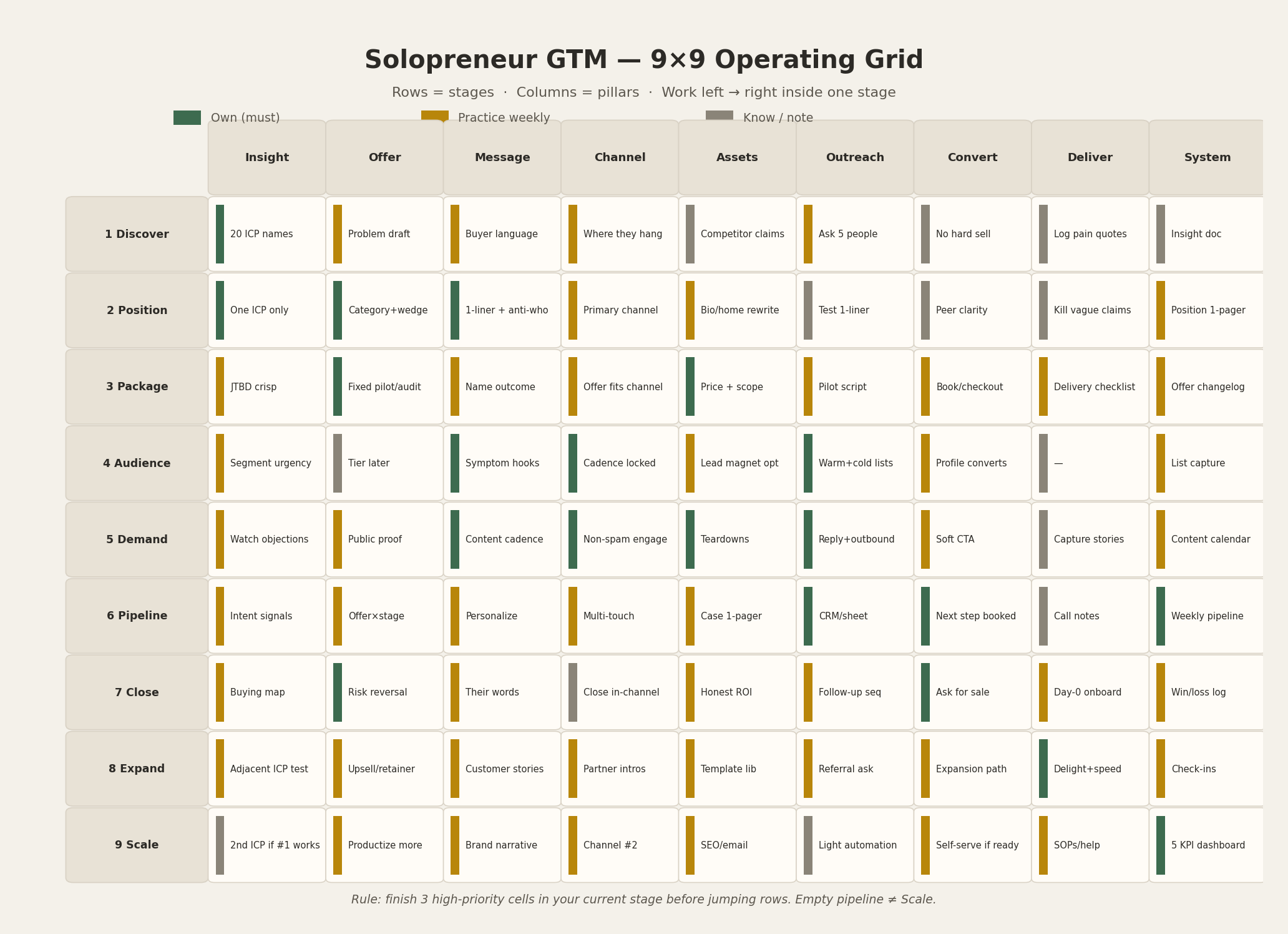
Own (must) Practice weekly Know / note
Interactive matrix (scroll sideways on phone)
Own Practice Know Tip: pick only 3 cells for the next 14 days.
90-day path
Days 1–15 — Discover + Position
Outcomes: one ICP paragraph, one problem sentence, ten interview notes, primary channel chosen.
Daily: 30–60 minutes talking to buyers or studying their public complaints.
Kill criteria: if you cannot name a person who feels the pain weekly, stop polishing assets.
Days 16–30 — Package + Assets
Outcomes: priced wedge offer, bio/landing match the offer, proof artifact v1.
Daily: one useful public post or teardown; five high-quality engagements on ICP accounts (no identical scripts).
Kill criteria: if nobody understands the offer in one read, rewrite before buying traffic.
Days 31–60 — Demand + Pipeline
Outcomes: channel cadence, CRM/sheet, ≥8 conversations/month, first paid or serious pilot.
Daily: create block and pipeline block as separate time.
Kill criteria: zero replies after ~40 quality touches → fix message/ICP, not volume.
Days 61–90 — Close + System
Outcomes: repeatable close path, one case study, weekly KPI review, decide double-down vs pivot.
Only then: channel two, light paid, or partner motion.
Minimum viable GTM week
| Block | Time | Work |
|---|---|---|
| Create | 2–3 hrs | One strong post/thread/teardown + one asset improvement |
| Engage | 2–3 hrs | Replies/DMs that add insight |
| Outbound | 2 hrs | Named ICPs, audit or pilot invites |
| Pipeline | 1 hr | Follow-ups, proposals, scheduling |
| Learn | 1 hr | Win/loss + one experiment decision |
Five numbers that matter early
- Conversations per week with real ICPs
- Offers sent (pilot, audit, call booked)
- Closes (paid or committed pilot)
- Content that earned intent (saves, quality replies, profile→site)
- Delivery time / satisfaction on the wedge offer
SellTheClick example
SellTheClick helps brands audit Meta creative libraries for clustering and waste before they scale spend. That is a GTM problem as much as a product problem.
- ICP: DTC media buyers and growth leads who already feel “one ad spends all,” fake diversity, or CPA spikes after creative volume.
- Position: against “ship 50 AI variants” hype — find the leak (cluster, message match, post-click) before more budget.
- Primary motion now: content + non-spam engagement in the buyer graph, with an audit-style wedge.
- Scale later: self-serve product path and agency partners after repeatable cases.
Before you scale creative volume
If Meta is concentrating spend on one ad or your “variations” look identical in the first frame, audit the library before you buy more chaos.
Run a creative audit on SellTheClickFAQ
What is a GTM strategy in one sentence?
How a specific offer reaches a specific buyer, gets paid for, and expands under your real constraints.
Can a solopreneur learn GTM without a marketing background?
Yes. Start with interviews, one channel, a wedge offer, and weekly metrics. Judgment comes from closed loops, not from memorizing frameworks.
Should I do PLG or sales-led first?
If strangers get value in minutes with simple pricing, PLG is on the table. If the product needs diagnosis or the ACV supports calls, lead with outbound plus a fixed-scope offer while you learn.
How is the 9×9 grid different from a generic marketing checklist?
It forces stage discipline. Most solos skip Discover and Package, then spam Demand. The grid makes “what stage am I in?” the first question.
How many hours per week?
Five to ten protected hours is a realistic floor. Below that you get random acts of content, not a motion.
When do I add a second channel?
After the first channel produces repeatable conversations and at least a thin pipeline — usually not before day 60–90 of focused work.
Bottom line
GTM for a solopreneur is choosing a customer, packaging a sharp offer, showing up on one channel until the market talks back, and turning conversations into paid proof. The skills are learnable. The scarce resource is focused reps — not another strategy PDF.