Meta Entity ID and Creative Similarity Audit Checklist
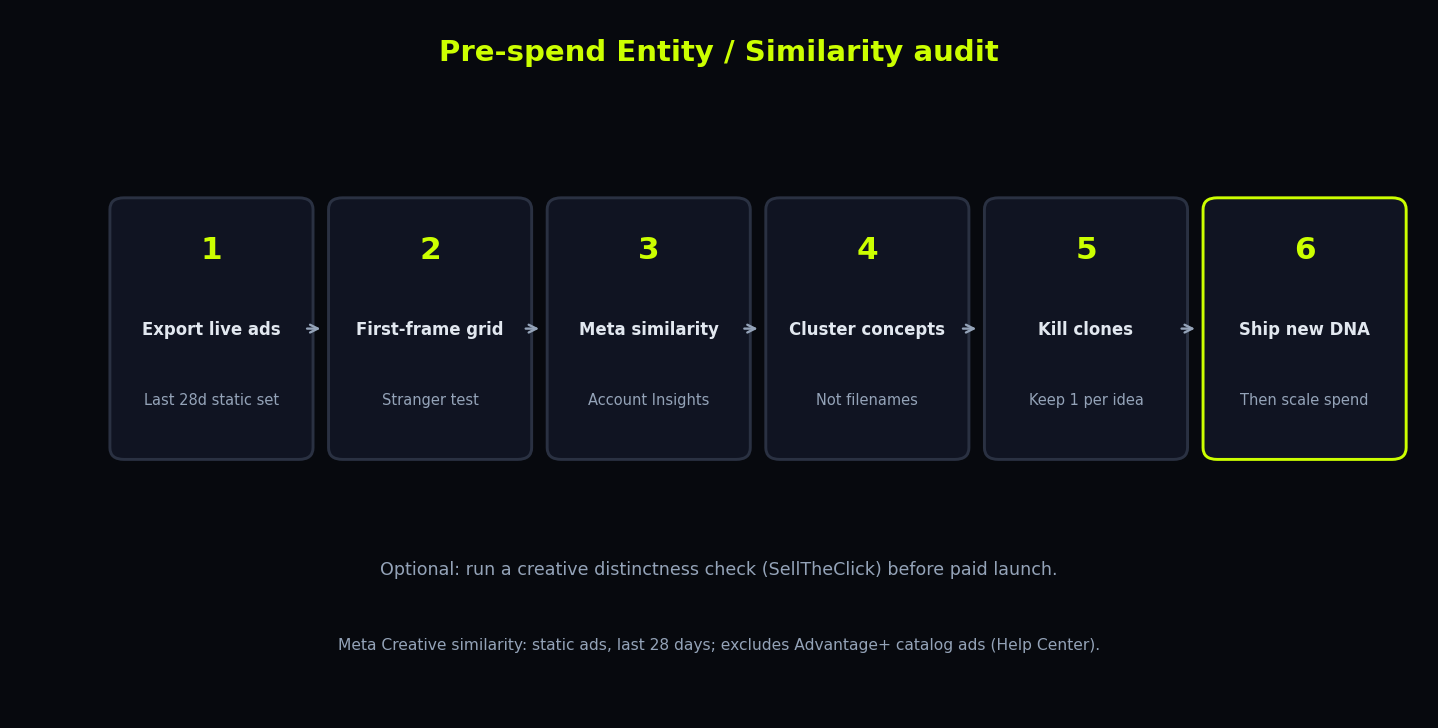
Direct answer: Before you spend another week testing “variations,” run a pre-spend audit: export the live static set, grid first frames, check Account Insights similarity when available, cluster by concept not filename, kill clones, then ship new visual DNA. Tools help when the library is big. They do not replace honesty about identical first frames.
Who this checklist is for
- DTC or agency teams about to launch a “big creative test.”
- Accounts where one ad repeatedly eats the budget across twin UGC.
- Anyone who already read the Entity ID explainer and still needs a ship/no-ship gate.
If you only needed the vocabulary, stop and read What is a Meta Entity ID? instead. Do not turn every meeting into an audit theater.
What Meta gives you (use it)
Creative similarity in Account Insights flags visually identical images/videos among static ads active in the last 28 days, notes efficiency risk, and points you to unique creative. It excludes Advantage+ catalog ads. Fatigue is separate.1
Andromeda is retrieval infrastructure for evaluating large creative volumes from automation and gen-AI workflows.2 Diversification is explicit company guidance, not a Twitter invention.3
Your checklist should respect those scope limits. Do not grade a catalog Advantage+ set with a static-similarity ritual Meta already excluded.1
The 6-step pre-spend audit
Step 1 — Export the right set
Pull currently active (or last-28-day) static ads you actually care about. Separate catalog Advantage+ lines into their own bucket so you do not misread Meta’s similarity scope.1
Minimum fields: ad name, spend, impressions, CTR or CPA if mature, creative thumbnail or video link, created date.
Step 2 — First-frame grid (stranger test)
Paste first frames into one board. Cover brand marks. Ask: would a stranger say these are different ads?
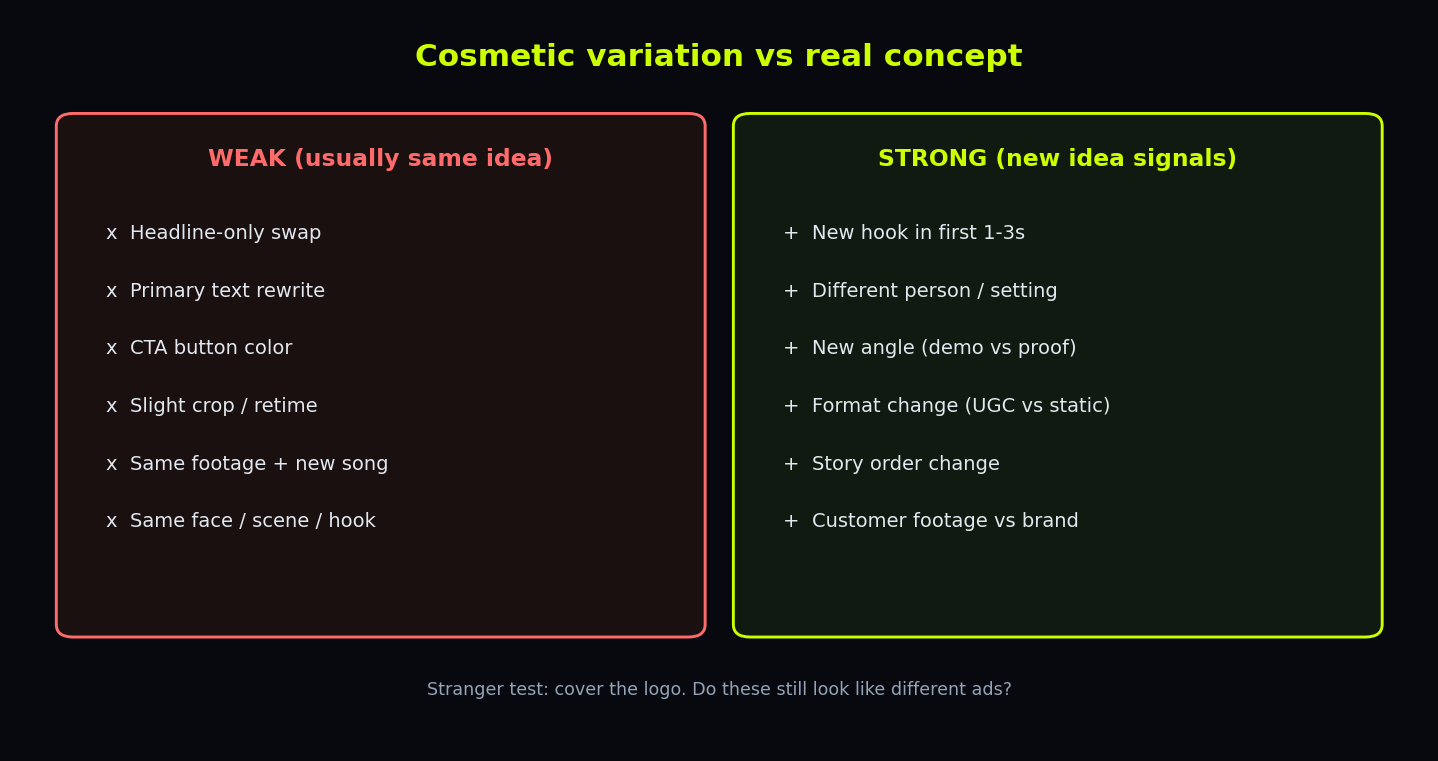
Failing the stranger test is enough to pause spend. You do not need a mystical ID number.
Step 3 — Account Insights similarity and fatigue
When the module exists, open Account Insights and read Creative similarity and Creative fatigue as different problems.1 High similarity with twin first frames is a library issue. Fatigue on a true winner is a refresh issue. Mixing them creates dumb briefs.
If the module is missing on your account, Meta notes availability can vary.1 Continue with the grid. Do not invent a score.
Step 4 — Cluster by concept, not filename
Group ads that share:
- Same person + setting
- Same first-second hook visual
- Same demo blocking and product framing
- Same story spine with only text costumes
Each cluster is one idea. Count clusters, not rows. This is the operational meaning behind “Entity ID” talk in buyer land.
Step 5 — Kill clones; keep one champion per idea
Inside each cluster, keep the best historical executor (or the cleanest creative). Pause the rest. You are not “reducing tests.” You are removing fake tests that steal exploration oxygen.
Meta’s similarity remedy direction matches this: unique creative when visuals are too identical.1
Step 6 — Ship new DNA, then spend
Only after the library is honest do you add concepts. Aim for differences Andromeda-era retrieval can actually use: different hooks, formats, people, settings, proof styles.23
Then launch. Then watch delivery share. Then decide scale vs replace. Related concentration guide: one ad takes all budget.
Ship / no-ship gate
| Gate | Ship | No-ship |
|---|---|---|
| Stranger test | Clearly different first frames | Twins with new filenames |
| Concept count | 3+ true concepts for the test job | 1 concept × 12 costumes |
| Similarity insight | No red flag, or fixed after pauses1 | Flagged identical static set ignored |
| Catalog mix | Catalog lines separated | Static checklist forced onto catalog1 |
| Learning hygiene | Stable setup planned | Daily reset culture baked in4 |
When a tool is worth paying for
Manual grids work until they do not.
- Worth it: 50+ active creatives, multi-brand ops, weekly launches, no time for human clustering.
- Not worth it yet: eight ads, obvious twins, one brand designer who can see the board.
SellTheClick is built for the “are these actually distinct before I spend?” job—visual/structural distinctness, not another vanity dashboard. Use it after step 2 honesty, not instead of it. If you want competitive tool context later, read SellTheClick vs Foreplay and creative automation platforms with a skeptical eye.
What we will not claim
- No guaranteed ROAS lift table.
- No fake “official Entity ID API.”
- No universal 40% similarity law unless Meta publishes one in Help Center.
- No promise that catalog ads behave like static similarity cards.1
90-minute team version
- 0–15 min: export and separate catalog vs static.
- 15–40 min: first-frame grid + stranger test.
- 40–55 min: Account Insights notes.1
- 55–75 min: cluster and pause clones.
- 75–90 min: brief 3–5 new concepts; schedule shoot/source; only then set budget.
Scorecard you can paste into Notion
| Item | Score 0–2 | Notes |
|---|---|---|
| Stranger test pass rate | 0 = twins, 2 = obvious concept gaps | |
| Concept count for this test job | Count clusters, not ads | |
| Account Insights similarity reviewed | Or marked unavailable1 | |
| Catalog lines separated | Required by Meta scope1 | |
| Clone pause completed | One champion per cluster | |
| New DNA briefs written | Hook, person, setting, proof, first frame | |
| Learning hygiene planned | No daily thrash4 |
Ship only if total is not propped up by wishful scoring. A 2 on “we have twelve ads” is cheating. Ads are not concepts.
Red-team questions (ask before budget approval)
- If we deleted filenames and only kept first frames, how many unique ads remain?
- Which ads would Meta’s static similarity lens even apply to?1
- Are we about to reset learning again for no structural reason?4
- Is this test designed to learn concepts or to comfort stakeholders with volume?
- If one ad takes 85% after a fair explore window, will we scale it—or panic and clone it?
If question 1 answers “one,” stop the meeting. You do not have a media problem yet. You have a production problem.
After the launch: two week review loop
- Day 3: delivery share snapshot. Twins still live? Pause them.
- Day 7: concept-level read, not ad-name vanity.
- Day 14: refresh the losing concept families with new DNA, not new captions. Re-check Account Insights if static non-catalog volume exists.1
This loop is where authority compounds. Most teams audit once, then drift back to costume volume because it is easier to brief a copywriter than a shoot.
Example brief template (copy this)
For each new concept, force the team to fill blanks before production:
- Job: cold prospecting / retarget proof / objection crush
- Person on camera: (must differ from live twin set)
- Setting:
- First-frame description: what is visible at 0.0s
- Spoken or on-screen hook (0–3s):
- Proof device: demo / review / data / before-after careful claims
- Why this is not Concept X already live: one sentence, brutal
If the last bullet cannot be answered without mentioning headline text, the brief is a costume request. Reject it.
FAQ
What is the fastest Entity ID audit?
First-frame stranger test. If twins fail that, stop spending on costumes.
How do I check Meta Creative similarity officially?
Account Insights documents Creative similarity for static ads active in the last 28 days; excludes Advantage+ catalog ads.1
Should catalog campaigns use this checklist?
Not the static similarity slice. Meta excludes Advantage+ catalog ads from that insight.1 Keep a separate catalog creative process.
When is winner-take-most acceptable?
When concepts were distinct and one earned share fairly. Details: MOFU diagnosis.
Do I need SellTheClick to pass the gate?
No. Need honesty and distinct concepts. Use a tool when volume makes manual clustering slow.
What Meta sources should my team bookmark?
Account Insights Help,1 Andromeda Engineering,2 diversification Business news,3 learning phase Help.4
Can I keep twelve headline variants of one video?
You can. Treat them as one concept for planning. Do not call it twelve tests.
Bottom line
Authority here is boring: respect Meta’s published similarity scope, stop buying costumes, ship real concepts, then spend.123 The audit is a gate, not a personality.
If the grid already shows twins, you do not need another article. Pause clones. Brief new DNA. Launch clean.
References
- Meta Business Help Center — About Account Insights in Meta Ads Reporting (Creative similarity and fatigue; 28-day static scope; catalog exclusion)
- Engineering at Meta — Andromeda retrieval engine
- Meta for Business — Diversification with Meta Andromeda
- Meta Business Help Center — About the learning phase
- Meta Business Help Center hub (start point if Account Insights UI paths move)