What Is a Meta Entity ID? (Plain English)
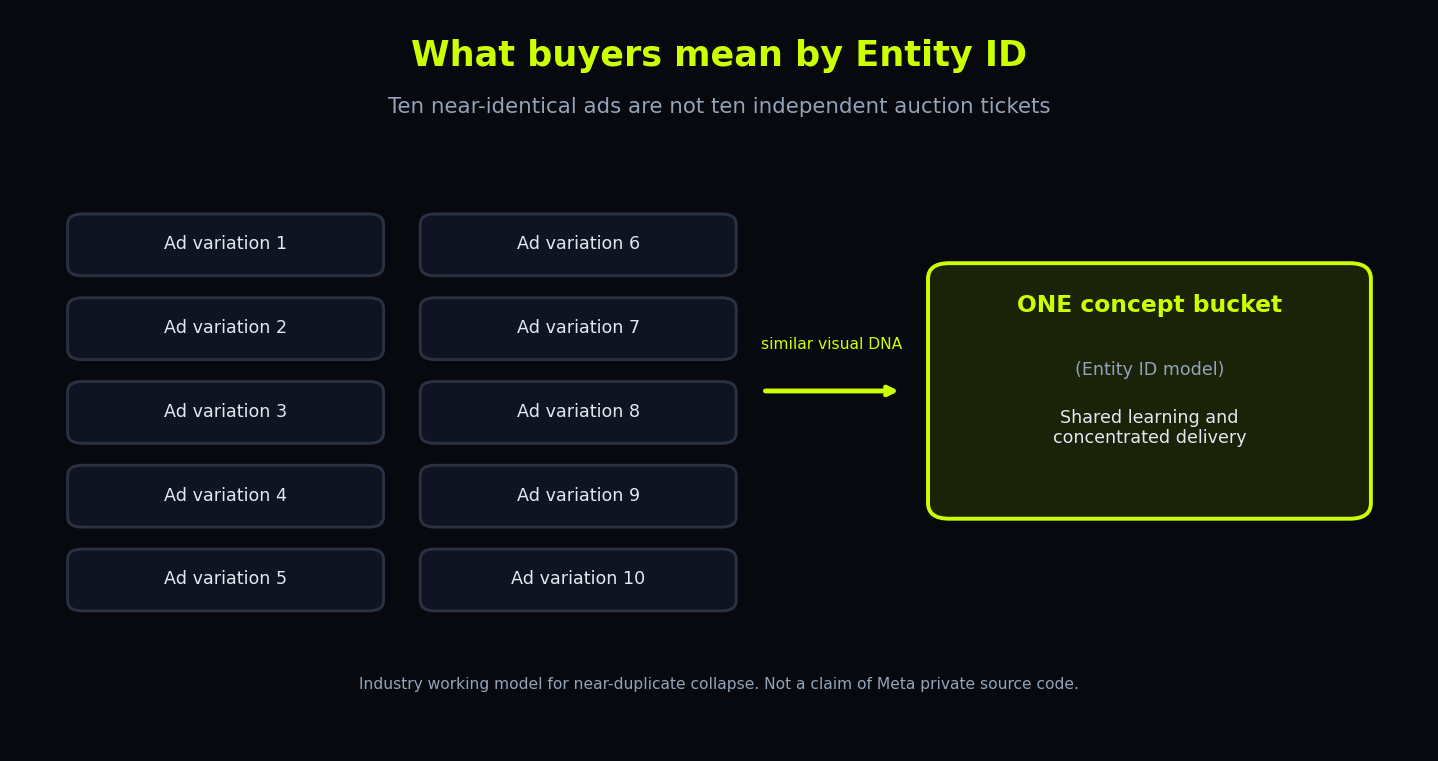
Direct answer: A “Meta Entity ID” is not a field you click in Ads Manager. It is the name media buyers use for a simple idea: Meta often treats near-identical ads as one creative idea, not as ten independent tests. You upload ten files. The system behaves like you uploaded one idea wearing ten outfits.
The confusion that sends people here
You built “variations.” New headlines. New primary text. Maybe a CTA color change. Maybe a slight crop. Ads approved. Campaign is on. Then Ads Manager shows the ugly pattern:
- One ad eats most impressions and spend.
- The siblings sit near zero.
- You refresh every hour hoping the system “learns.”
- Someone on Twitter says “Entity IDs” and suddenly that is the villain.
Sometimes the villain is real: your set was never ten ideas. Sometimes the system found a true winner and is doing its job. Both can look identical on day one if you only stare at spend share.
What Meta actually published (start here)
Skip the rumor stack for a minute. Three primary sources matter.
1) Andromeda is a retrieval engine
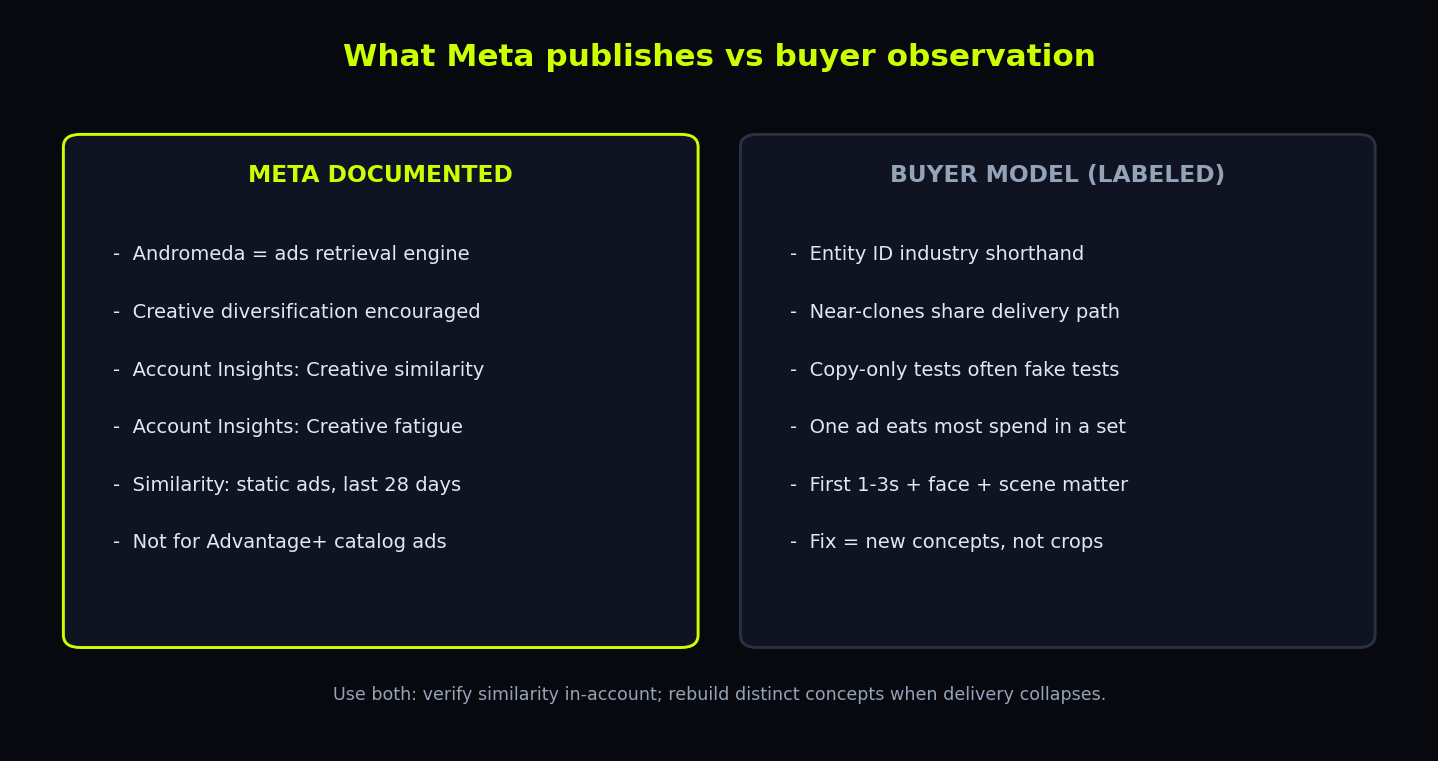
Engineering at Meta describes Andromeda as a next-generation personalized ads retrieval system. Retrieval is the stage that shortlists candidate ads from a huge eligible pool before later ranking. Meta built it partly because Advantage+ and generative creative tools flooded the system with far more ads to evaluate.1
Buyer translation: the machine is better at scanning a big creative library. That helps you only if the library contains different ideas. Ten clones do not become ten retrieval opportunities just because you renamed the file.
2) Meta wants creative diversification on purpose
In Meta’s own Business news on creative diversification and Andromeda, the company argues that more diverse creative helps personalization at scale, and positions Andromeda as infrastructure for handling that volume. Meta also points advertisers toward tools like Advantage+ creative to diversify assets.2
Notice what they emphasize: diversity of creative, not “make twelve headline AB tests of the same video.”
3) Creative similarity is a real in-product signal
Meta’s Help Center page on Account Insights documents Creative similarity: it flags when images or videos in your ads appear too visually identical, notes that this can contribute to fatigue and higher cost per result, and recommends creating new ads with unique creative. Important constraints from Meta’s own copy: similarity insights are based on static ads active in the last 28 days and do not include Advantage+ catalog ads. The same page documents Creative fatigue separately.3
So what is an “Entity ID” in plain English?
Think of three layers buyers mix up:
| Layer | What it is | Who talks about it |
|---|---|---|
| Ad / Creative ID | The object you create in Ads Manager | Everyone |
| Creative similarity | Meta’s Account Insights signal for visually identical static ads | Meta Help3 |
| “Entity ID” | Buyer shorthand: “these ads got treated as one idea” | Practitioners / agencies |
When people say “same Entity ID,” they usually mean: the system is not giving these siblings independent exploration. Delivery concentrates. Learning feels shared. Your “test” was mostly cosplay.
That model is useful. It is still a model. If Meta never prints the words “Entity ID” on a Help article, that does not make your delivery problem imaginary. It means you should diagnose with symptoms + Account Insights + first-frame reality, not with mystical IDs.
Why beginners care (and why veterans still get burned)
Small accounts feel this first because every dollar is visible. You cannot hide a dead ad inside $2M/month noise.
But big brands get burned too, just louder. They ship 80 “variations” from one hero UGC, celebrate volume, then watch three ads take the budget while the rest decorate the table. Meta’s diversification messaging exists because volume without difference is expensive theater.2
Entity problem vs creative fatigue (do not merge them)
Meta separates these in Account Insights for a reason.3
- Fatigue: the audience has seen the same creative too many times. Performance decays over exposure.
- Similarity / “entity” collapse: siblings never really competed as separate ideas. Concentration can happen early, before classic fatigue has time to matter.
If day-one spend is 92% on one twin and the other nine look identical in a first-frame grid, stop calling it fatigue. You built one concept.
What usually does not create a new idea
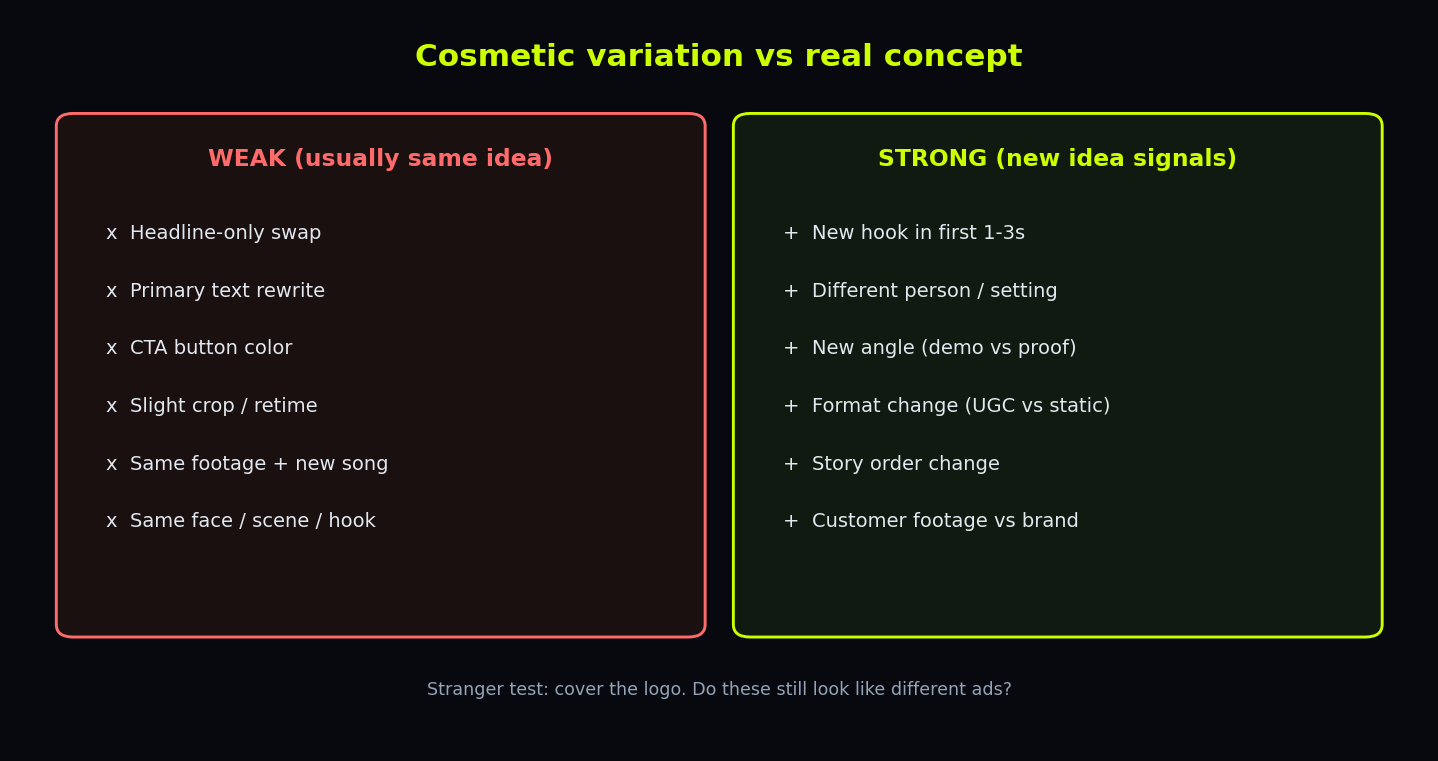
Weak changes (buyer observation, widely shared):
- Headline only
- Primary text only
- CTA label or button color
- Slight crop or 0.5s trim
- Same footage, new stock music
Stronger changes:
- Different first 1–3 seconds
- Different person, setting, or product demonstration style
- Different angle (demo vs proof vs myth-bust vs founder)
- Different format family (talking head vs static vs UGC screen-record)
- Different story order (problem-first vs result-first)
Meta’s similarity guidance is blunt on the fix direction: create new ads with unique creative when similarity is the issue.3 That lines up with what serious accounts already do.
Andromeda in one paragraph (no hype)
Andromeda is Meta’s retrieval-layer rebuild so the ads system can handle more creative candidates with heavier models.1 It is not a switch that “killed interest targeting overnight,” and it is not a personal insult aimed at your brand. It raises the cost of lazy libraries. If your creative strategy was “duplicate and hope,” retrieval quality improvements make that strategy look worse, not better.
How this series is split (so we do not cannibalize ourselves)
TOFU (this page): what people mean by Entity ID, what Meta documents, what to stop mixing up.
MOFU: why variations get 0 impressions — diagnosis, check path, repair plan.
BOFU: pre-spend audit checklist — when to kill clones, when a tool is worth it.
Related symptom guide: why one ad takes all budget.
A 10-minute starter check (no tools required)
- Open the ad set. Sort by spend or impressions.
- Screenshot first frames of the top 8 ads into one grid.
- Cover logos with your hand. Would a stranger call these different ads?
- If no: you have a concept problem, not a “Meta hates me” problem.
- If yes: check structure (learning resets, tiny audience, odd caps) and Account Insights for similarity/fatigue when available.3
Common beginner mistakes
- Treating filename count as creative diversity.
- Blaming Andromeda for every uneven spend chart.
- Forcing equal delivery on junk siblings.
- Reading Twitter threads as if they were Help Center docs.
- Skipping Meta’s own similarity constraints (static / 28 days / not catalog).3
- Writing twelve hooks on one kitchen UGC and calling it a test matrix.
FAQ
What is a Meta Entity ID?
Buyer shorthand for “Meta treated these ads as one creative idea.” Meta’s public product language emphasizes Creative similarity and creative diversification; Engineering documents Andromeda as retrieval infrastructure.123
Is Entity ID an official Ads Manager column?
Do not expect a universal “Entity ID” column labeled that way. Use delivery symptoms, first-frame review, and Account Insights creative similarity where available.3
Is Creative similarity the same thing?
Related, not identical branding. Creative similarity is Meta’s documented insight for visually identical static ads in Account Insights.3 “Entity ID” is the street name buyers use for collapse behavior.
Did Andromeda invent this problem?
No. Near-duplicate ads concentrated delivery before 2024 too. Andromeda raises the stakes because retrieval is built for larger creative volume.1
Why do my ad variations get zero impressions?
Often because they are not true variations, or a real winner is taking efficient share, or structure blocks exploration. Deep diagnosis: MOFU guide.
Does changing the headline create a new entity?
Usually not, if the visual story is identical. Meta’s similarity notes focus on images/videos looking too identical.3
Where should I go next?
If you need the repair playbook, open the MOFU article. If you need a pre-spend checklist before another $5k test, open the BOFU audit.
Bottom line
Entity ID talk is useful when it forces a hard question: did we ship different ideas, or different costumes? Meta’s public materials push the same direction with different words—retrieval capacity, diversification, and similarity warnings.123
Next: diagnose live delivery in Why your ad variations get 0 impressions.
References
- Engineering at Meta — Andromeda: next-gen personalized ads retrieval engine (retrieval stage; capacity for Advantage+ / gen-AI creative volume).
- Meta for Business — Unlocking the power of diversification with Meta Andromeda (creative diversification framing; Advantage+ creative context).
- Meta Business Help Center — About Account Insights in Meta Ads Reporting (Creative similarity and Creative fatigue definitions and scope limits).
- Meta for Business — Meta Andromeda related creative advantage coverage hub (company narrative on creative volume and personalization; use alongside Engineering post).